
What Plankton Know About Surrender

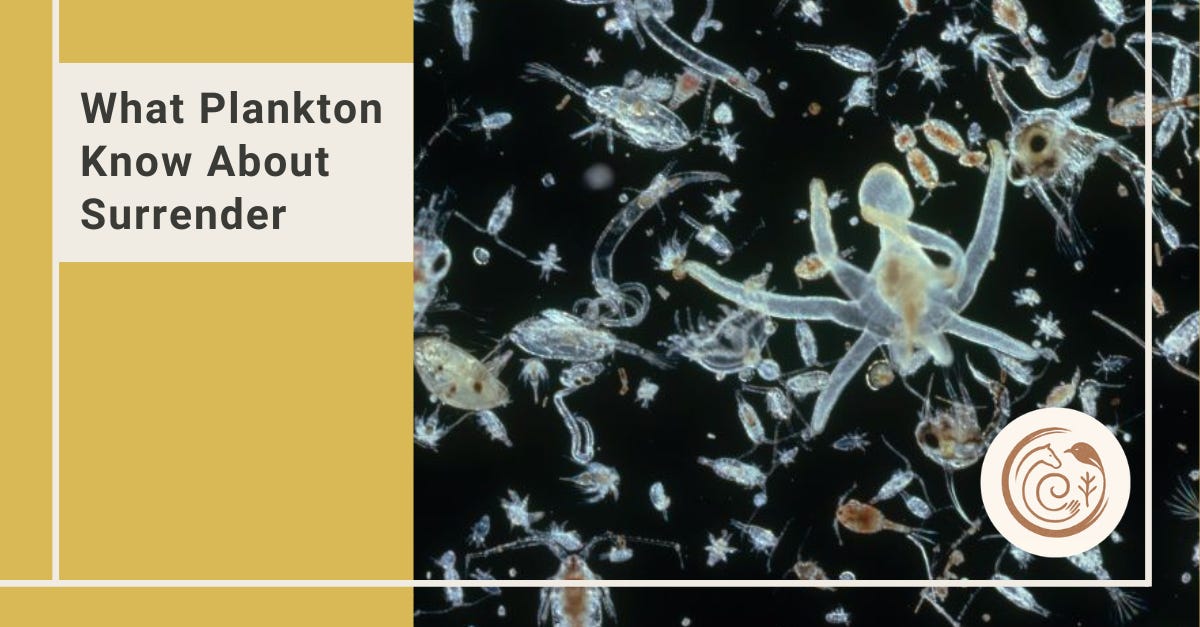
The large, the charismatic, and the clearly visible beings catch our attention easily. Whales. Elephants. Horses. Ancient oaks. But the foundation of almost every marine ecosystem on Earth belongs to organisms that most people will never see — many of them single-celled, translucent, and drifting.
The word plankton comes from the Greek planktos: wanderer. Drifter. The name itself tells you how we’ve categorized them — by what they aren’t doing. They don’t swim against currents. They don’t choose a destination the way a sea turtle or a whale can. By every measure of agency that Western intelligence frameworks value — autonomy, directed movement, individual will — plankton seem to fall outside the frame.
What if we change what we measure?
When I look at plankton through the Perceive / Relate To / Apply framework, the first thing that refocuses is the Perceive dimension. Phytoplankton — the plant-like plankton that photosynthesize — perceive light with extraordinary sensitivity, adjusting their position in the water column to optimize photosynthesis across changing conditions. Zooplankton perform daily vertical migrations, rising toward the surface at night to feed and descending into darkness during the day. This is the largest synchronized migration on the planet, and it happens every single day, involving billions of organisms moving in concert across hundreds of meters of water depth.
They perceive light gradients, chemical concentrations, pressure changes, and the presence of predators through molecular signaling. Their perceptual world is intimate, scaled to micrometers and chemical traces, but it is continuous, responsive, and astonishingly precise.
The Relate dimension is where plankton asks me to reconsider an almost invisible assumption. Meaning-making is most often associated with individual experience — a being perceives something, holds it internally, and generates understanding. But plankton relate to information both internally and collectively. Phytoplankton blooms emerge when millions of individual organisms respond to the same environmental signals — nutrient upwelling, light availability, water temperature — and their collective response creates a visible, living event that can be seen from space.
No individual plankton decides to bloom. The bloom is a relational event through multiple dimensions — meaning emerging not from within a single organism but from the space between millions of them, all relating to the same information simultaneously. It’s a different grammar of meaning-making than what we find in dolphins or horses, but the framework holds it. The question isn’t whether plankton make meaning — it’s expanding our willingness to recognize intelligence in action.
Their Apply dimension is where the scale expands. Phytoplankton produce between 50 and 80 percent of the oxygen in Earth’s atmosphere. They absorb roughly 40 percent of all CO2 produced globally. They form the base of nearly every marine food web. When plankton apply the intelligence, simply through their way of being — when they photosynthesize, when they bloom, when they migrate, when they die and sink to the ocean floor carrying carbon with them — they are regulating the chemistry of the planet.
The entire atmosphere you’re breathing through right now was shaped by organisms we can’t see, doing something we barely recognize as intelligence, through a form of participation that looks nothing like agency as we’ve defined it.
The expression of their brilliance inspires awe, and maybe some self-reflection. Plankton don’t resist the current. They don’t fight for position. Their intelligence doesn’t express itself through control or direction. It expresses itself through responsiveness — through an exquisite sensitivity to conditions, a willingness to be moved, and a participation so fundamental that life on Earth depends on it.
We’ve built our understanding of intelligence around the capacity to conceptualize and act on the world. Plankton suggest that some of the most consequential intelligence on the planet operates through the capacity to respond to it — to be moved, literally, by the conditions of life, and in being moved, to sustain everything.
I wonder what we might learn if we valued that. Not as a lesser form of intelligence that couldn’t manage autonomy, but as a mastery of something we’ve forgotten how to practice: the intelligence of surrender to participation in something larger than ourselves.
Enter “plankton” in the Research Explorer to explore their full P/R/A intelligence profile. Or ask PRAcel what plankton might reveal about the difference between agency and participation.
Another amazing article, I feel so insignificant to what is really happening around us thank you for bringing the awareness forward
"to be moved, literally, by the conditions of life, and in being moved, to sustain everything."💕